
Yamato 1 • Caterpillar drive
Yamato 1 • Caterpillar drive |
Magnetohydrodynamics
| |||||||||||||||
|
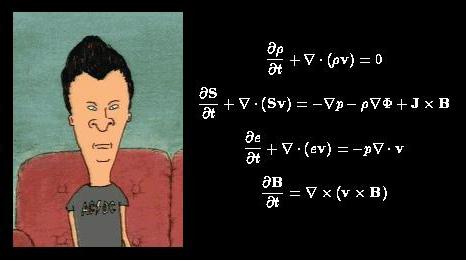
| Magnetohydrodynamics Simple Equations |
A computer actuated relay clicks in the small control room at Israel’s Ben Gurion University of the Negev. Nearby, a two story high power generator starts up.… But there’s a strange silence. There’s no whine from high speed turbine blades, no hum from copper generator coils whirring in a magnetic field, no hiss of pressurized, superhot steam. That’s because
Electropaedia writes: "Magnetohydrodynamic power generation provides a way of generating electricity directly from a fast moving stream of ionised gases without the need for any moving mechanical parts - no turbines and no rotary generators. Several MHD projects were initiated in the 1960s but overcoming the technical challenges of making a practical system proved very expensive. Interest consequently waned in favour of nuclear power which since that time has seemed a more attractive option." 4
In place of a propeller or paddle wheel, [the
 |
 Yamato II |
| The boat, 30m/100ft long, was designed to travel at 8 knots. – Brock Hampton, Dictionary of Science (London: Brockhampton, 1994), p. 356. |
|
1 “Magnetohydrodynamics (MHD),” Dictionary of Scientific Literacy, Richard P. Brennan (New York: John Wiley & Sons, Inc., 1992), p. 195.
2 Dennis Normile and Robert Langreth, “Superconductivity goes to sea,” Popular Science, Nov 1992.
3 John Free, “Now: liquid-metal MHD; magnetohydrodynamic power,” Popular Science, July 1985.
4 Electropaedia, "Battery and Energy Technologies: Magnetohydrodynamic (MHD) Power Generation," at http://www.mpoweruk.com/mhd_generator.htm (retrieved: 1 June 2014).
5 Normile and Langreth, “Superconductivity.”

|
The Magneto Hydrodynamic Explosive Munition (MAHEM) program offers the potential for higher efficiency, greater control, and the ability to generate and accurately time multiple jets and fragments from a single charge. |

|
A little frog (alive !) and a water ball levitate inside a Ø32mm vertical bore of a Bitter solenoid in a magnetic field of about 16 Tesla at the Nijmegen High Field Magnet Laboratory. |

|
The 1,500-pound Dodge Tomahawk can reach 60 miles an hour in about 2.5 seconds, and has a theoretical top speed of 300 mph. |

|
Solotrek XFV Exo-skeletor Flying Vehicle |
MAHEM (Magneto Hydrodynamic Explosive Munition): "Science fiction inspires DARPA weapon," 22 April 2008, at http://www.newscientist.com/blog/technology/2008/04/science-fiction-inspires-darpa-weapon.html (Retrieved: 25 April 2008).
|
HTML Comment Box is loading comments...
|
